Small Business Reinvention
Doing More Than Surviving the AI Era
Carl Brazley, CEO · Edited by Jules Whitfield
The business world is changing, but the transformation underway is about more than artificial intelligence. It is also about culture: how we work, how organizations solve problems, how communities create opportunity, and how businesses define their value in an increasingly uncertain economy.
Rising costs, shifting federal policies, economic uncertainty, and rapidly advancing technology are forcing small businesses to reconsider familiar strategies. For some, survival means cutting expenses. For others, it means rethinking the business itself.
Louisville-based 7PM Group LLC is pursuing the latter approach.
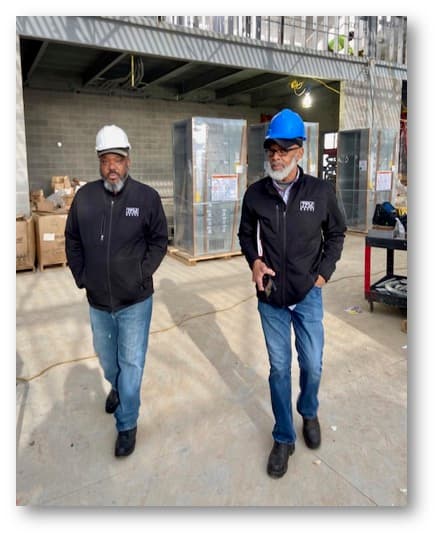
With experience in construction management, strategic sourcing, contractor development, and community engagement, 7PM has expanded its capabilities by combining industry expertise with proprietary, AI-assisted tools. Its approach reflects a broader cultural shift: moving beyond traditional organizational boundaries to find new ways to deliver value.
Consider 7AM—Complete Asset Management. Drawing on the biblical symbolism of seven as a number of completion, 7AM incorporates digital mapping, semi-digital twin models, and specialized AI-assisted teams supporting architecture and engineering design, finance, and marketing.
Working with Jefferson County Public Schools (JCPS), 7PM used 7AM to create a digital map of district-owned properties while supporting efforts to manage contractor utilization across capital construction projects. The work illustrates how technology and outside expertise can help institutions tackle complex challenges without requiring every capability to reside within their own teams.
Another example is The Zine, 7PM's digital magazine featuring people, culture, business, technology, and new ideas. Working with the City of Louisville, 7PM used the publication to highlight the Human Relations division's success in utilizing local small businesses and to tell the stories of companies thriving through hard work, creativity, and persistence. Both the city and featured businesses praised the articles and the responses they generated.
Together, these initiatives reveal a different way of thinking about business. Technology is not simply a tool for reducing costs. It can enable new services, connect people with opportunities, and help organizations operate differently. Community engagement is not merely a requirement to fulfill; it can become a platform for building relationships and strengthening local economies.
This is a cultural change as much as a technological one. It challenges the assumption that small businesses must remain small in their capabilities, that institutions must solve every problem internally, or that economic development is measured only in dollars spent.
AI will continue to change what businesses can do. The larger question is whether we will change how we think about what businesses, institutions, and communities can accomplish together.
For small businesses, the opportunity is not simply to survive the AI era. It is to help shape what comes next.
About the author
Carl Brazley — CEO
Edited by Jules Whitfield